
What school attendance data misses

Updated: 4 days ago
In school, but drifting away
A pupil can be in school every day and still be drifting away from it. They may pay less attention, leave more work unfinished, take more breaks or seem less present than usual. Their attendance may not raise any concerns, but their experience of school has already begun to change.
Kearney’s clinical indicators describe established attendance difficulties as missing at least 25% of school time over two weeks, or having severe difficulty attending for at least two weeks in a way that significantly disrupts everyday life. By then, however, the difficulty may already be hard to shift. Schools therefore need ways to notice change while the pupil is still attending.

Once absence begins, home may feel safer and school harder to face. Missed learning, reduced confidence, changing friendships and anxiety can then create further barriers to returning. By the time attendance difficulties are evident, schools may be dealing with both the original difficulty and the barriers created by absence itself.
What might the attendance data be missing?
Attendance data records presence, absence and patterns across sessions, but it does not explain what the pupil’s behaviour means or why their relationship with school is changing. In our work at EPSS, missed or unmet SEND needs are often part of the picture, although the circumstances are different for every pupil.
Even once absence is visible, the figures do not tell us what started the difficulty or what is keeping it going. The original trigger may be different from the pressures pushing the pupil away from school, the reasons home or somewhere else feels easier, and the factors that now make returning difficult. The trigger may have happened outside school and may no longer be something anyone can change. What matters for planning support is understanding what is maintaining the difficulty now.
Attendance data may also miss the smaller changes that show whether support is beginning to work. A pupil may feel safer, more connected or more able to take part before this results in sustained improvement in attendance. Because no single approach works consistently for every pupil, schools need to track these changes in experience and enjoyment, using them to judge what is helping and adapt support.
Why school enjoyment matters
School enjoyment matters because it can begin to change while a pupil is still attending. It may show whether their connection with school is weakening or beginning to recover. ImpactEd Group studied more than 100,000 pupils across England and found that more than one in four began to disengage during Year 7. School enjoyment fell sharply too—from around 6.0 in Year 6 to 3.8 in Year 7, then to 3.2 in Year 8—and did not simply recover as pupils settled into secondary school. For Trusts, this makes enjoyment during transition an important early indicator.
This information gives Trust leaders a reason to look more closely before the difficulty becomes harder to shift.
What we have learnt about the levers for change
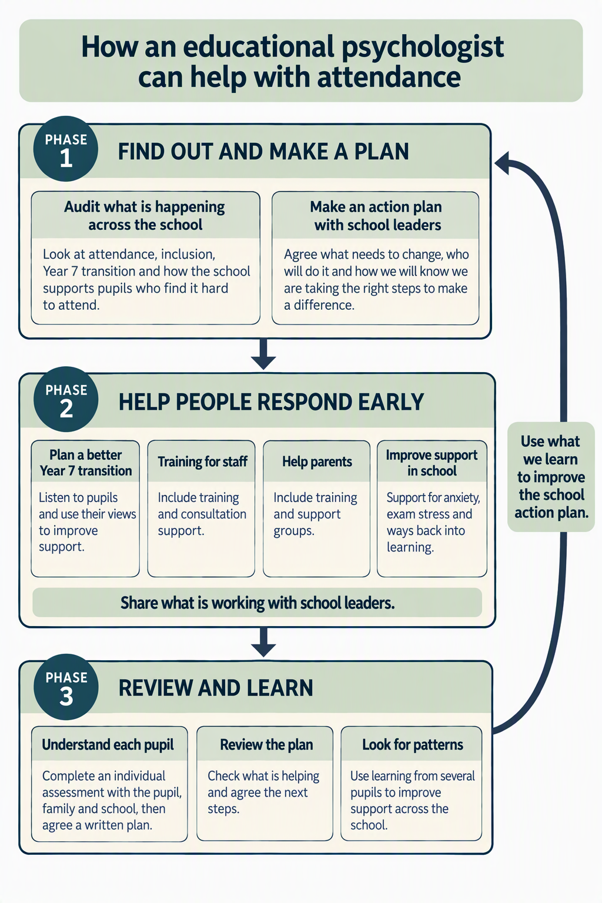
In our work, we have found that different levers are needed at different points. The starting point is often an audit that brings together enjoyment, attendance, inclusion, transition and current provision. This helps a school or Trust see the pattern more clearly and decide what needs to change.
When a pupil begins to drift away, an early consultation with an educational psychologist can help the school consider whether SEND needs have been missed or are not being met, and what might increase the pupil’s enjoyment of school. The consultation may point to changes in provision, support for the pupil and their parents, or areas where staff need more confidence. Schools can begin making these changes without waiting for an in-depth assessment.
If attendance is still not improving, a more in-depth assessment may be useful. It can help the team separate what first triggered the difficulty from the push, pull and maintaining factors affecting the pupil now. This gives a clearer basis for deciding what could change and how support should respond to the pupil’s needs.
Individual assessments can also tell the Trust something about its wider provision. Looking across cases may reveal recurring gaps in staff confidence, transition arrangements or the support available in schools. Those themes can then be built into school and Trust action plans, so that learning from individual pupils leads to wider change.
Three questions for Trust leaders
Attendance data alone is not enough. Trust leaders also need to ask:
· How do we know when pupils are beginning to drift away?
· How do we understand what is making school difficult?
· How do we provide the right support and know whether it is helping?
If these questions reveal gaps across your Trust, EPSS can help you review current practice, understand what is getting in the way and decide what support or wider change is needed.
References
Kearney, C. A. (2008). An interdisciplinary model of school absenteeism in youth to inform professional practice and public policy. Educational Psychology Review, 20(3), 257–282. doi:10.1007/s10648-008-9078-3.
ImpactEd Group. (2025). Mind the Engagement Gap: National findings on school transition, belonging and enjoyment.
Department for Education. (2024). Pupil experience data: belonging, safety, enjoyment, motivation and relationships with staff.
© Educational Psychology Services for Schools Ltd., 2026. Written by Dr Kathryn Gibb. You are welcome to use and share this blog and its accompanying resources within your school or setting, provided the source is acknowledged. Please do not sell, publish, adapt or reproduce the materials elsewhere without permission. These ideas are offered as general guidance to support behaviour planning, inclusion and relationships. They are not intended to replace professional judgement, individual educational psychology advice, school policy, safeguarding procedures or advice from relevant specialists. If a pupil’s behaviour, wellbeing or safety is causing concern, staff should follow their school’s usual procedures and seek appropriate support.



Comments