
Are your Trust’s behaviour plans reducing the likelihood of exclusion?

Updated: 7 days ago
A behaviour plan is in place and staff are following it. Yet the pupil is removed from class again. For Trust leaders, that raises a practical question: is the plan changing what happens next, or simply managing each incident until exclusion begins to look inevitable? The issue is not whether another process is needed. It is whether schools can understand what the behaviour may be communicating, identify the skills the pupil needs and judge whether support is changing the direction of travel.
Trust leaders need confidence that behaviour is managed safely, consistently and lawfully across their schools. Ofsted expects schools to remove barriers to participation and achievement yet plans vary considerably within the same Trust. Strong plans describe what staff see and hear and make support reviewable; weaker plans rely on labels such as “defiance” or “disruption”, leaving leaders unable to see what need the behaviour may be meeting or what should change.
Exclusion and pupil movement are Trust-level indicators. Department for Education data recorded 335,671 suspensions and 3,715 permanent exclusions in autumn 2024/25; although the suspension rate had fallen since the previous autumn, it remained well above its pre-pandemic level. Statutory guidance places these decisions within a legal and safeguarding framework and states that permanent exclusion should remain a last resort. Trust leaders therefore need a clear account of how support was planned and reviewed, how the pupil’s needs were understood and whether the plan improved their chances of remaining included.
What need might the behaviour be meeting?
Psychological formulation is a working explanation of behaviour, built from what is known about the pupil’s needs, development, relationships and context. It helps teams look beyond the immediate incident without weakening boundaries or overlooking risk. The explanation should lead to action by identifying what the pupil may be communicating, the skills that could help them meet that need and the barriers affecting their development or use.
Educational psychologists (EPs) add most value when they work alongside school teams before difficulties escalate, not only when a report is needed afterwards. They can help staff draw together what is known about the pupil and test different explanations against the evidence. This gives the team a stronger basis for deciding what should change in the adults’ responses, and which skills should be taught.
A pupil who shouts “go away” may need space, reassurance or a steady adult presence but be unable to show it. Withdrawing may reduce the immediate pressure while missing an opportunity to help the pupil request space, signal distress or repair the interaction. Other behaviours need the same careful thought: leaving may reflect overwhelm or a task the pupil cannot begin; refusing work may protect against failure; aggression may create distance when the pupil has no reliable way to protest.
Even when a pupil knows an alternative response, distress may make it unavailable. Language processing, anxiety, shame, sensory load, trauma, developmental delay or disrupted relationships can all affect access. A useful plan identifies both the skill to teach and what must change around the pupil so they can use it.
What does this mean for behaviour planning?
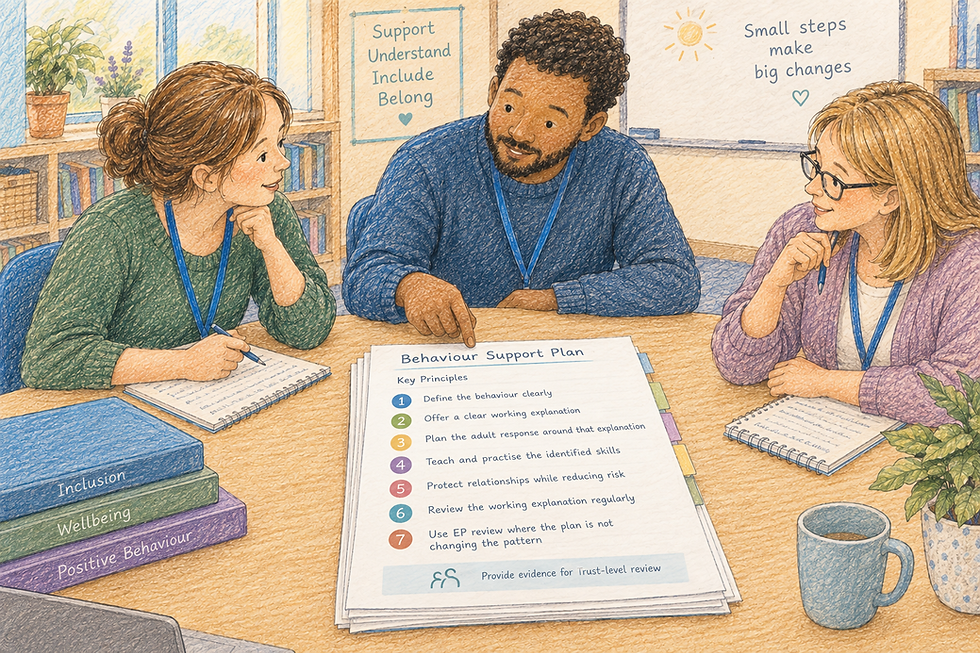
Across your Trust, do behaviour support plans…?
Define the behaviour clearly? Describe what is seen and heard, rather than relying on labels such as “defiance”, “aggression” or “disruption”.
Offer a clear working explanation? Set out what the behaviour may be communicating and the need it may be meeting. Record the evidence for that explanation and any barriers that make safer ways of meeting the need difficult to learn or use.
Plan the adult response around that explanation? Specify what adults will do before, during and after difficult situations to reduce risk and help the pupil access support or communicate differently.
Teach and practise the identified skills? State which skill is being taught, who will teach it and when it will be practised outside moments of distress. The plan should also show how adults will prompt and reinforce its use in real situations.
Protect relationships while reducing risk? Include how adults will maintain connection, notice the pupil’s strengths and support repair, so the plan is not organised only around incidents and risk.
Review the working explanation regularly? At least every six weeks, compare the plan with evidence about risk, recovery, participation and use of the identified skill. Decide whether the explanation still fits and what should be retained, changed or investigated.
Use EP review where the plan is not changing the pattern? Ask the EP to test competing explanations, identify gaps in the evidence and help the team decide what should change in provision or adult responses.
Provide evidence for Trust-level review? Use a consistent record of the behaviour, working explanation, support tried and changes seen. This should allow leaders to compare patterns between schools and judge whether reasonable alternatives were explored before exclusion was considered.
What can an EP add to reviews?
Educational psychologists can help reviews move beyond checking whether a plan was followed. By comparing the working explanation with evidence about risk, recovery, continuing triggers and the pupil’s use of the identified skill, the team can decide what to retain, change or investigate. Our behaviour plan review list above brings these questions together for Trust and school leaders.
The aim is a better-founded plan, not a perfect one. The explanation should fit the evidence, adults should respond consistently and early progress—such as quicker recovery or an easier return to learning—should inform small adjustments rather than leaving an ineffective plan untouched.
None of this requires schools to remove boundaries or lower expectations. Expectations become more achievable when the plan identifies the need and the skill to be learned, then specifies the support that will help the pupil develop it. A shared formulation gives staff an explanation they can test against evidence, rather than leaving them to respond only to the surface behaviour.
For MATs, this is an inclusion and oversight issue. Where exclusions, managed moves or off-site directions are rising, leaders need to examine how behaviour was understood, what support changed and whether barriers to participation reduced. Ofsted’s focus adds urgency, but the principle is wider: a defensible exclusion decision should follow defensible assessment, support and review.
Trusts cannot remove every barrier centrally, but they can ensure that schools have access to the expertise needed to respond well. Educational psychologists can help teams develop and review formulations so that the right skills are identified and support changes in response to evidence. Contact Educational Psychology Services for Schools for a free initial discussion about where EP input could make the greatest difference across your Trust.
© Educational Psychology Services for Schools Ltd., 2026. Written by Dr Kathryn Gibb. You are welcome to use and share this blog and its accompanying resources within your school or setting, provided the source is acknowledged. Please do not sell, publish, adapt or reproduce the materials elsewhere without permission. These ideas are offered as general guidance to support behaviour planning, inclusion and relationships. They are not intended to replace professional judgement, individual educational psychology advice, school policy, safeguarding procedures or advice from relevant specialists. If a pupil’s behaviour, wellbeing or safety is causing concern, staff should follow their school’s usual procedures and seek appropriate support.


Comments